Tuesday, 21 May 2013

Final Pages


The images were first completed and then brought together with the narrative in Adobe Photoshop. Unfortunately the timescales were tight in regards to completing the prototype of the book and sending it away to print. The intention is to use Adobe In-Design when it comes to designing the final and complete series of books titled ‘Autism: It’s The Little Things’. Each page contains an image and some text. The idea was to try and let the image tell the story rather than the text . The overall page layouts are very simple. The text is Kristen ITC. This particular font was chosen because it suited the scribbly, sketchy illustrations. The rounded lettering also tied in with the roundy faces the characters have. The typeface and the illustrations went together hand in hand. However the page layout is very basic. There seems to be too much of a white background. This allows for the colourful illustrations to stand out but it still looks very plain. It is fortunate that the completed prototype allowed for these mistakes to be made. There is an opportunity to explore typography. The final outcome will be the complete book with illustration and narrative and creative typography. The typography and the background need to change for the final books. They are far too plain. There is nothing exciting about them. The illustrations stand out and are very expressive and animated. The type face should match. This is something that will be taken into consideration for the final series of books.  


‘Book One: An Introduction’ was printed by Jessops. Jessops was chosen because the delivery timescales were quicker than that of Blurb and as mentioned previously, time was flying by quickly. Jessops have a series of photo book (cewe books) sizes available. The one chosen to be the final prototype for this project was the large cewe book that measured 21cm x 28cm. This was felt to be a decent sized book. It was not too small of too big. The hard cover was chosen. This gives the book a more professional feel and a strong finish. The overall prototype looks like a finished book but there is room for improvement. The typography, backgrounds and page layouts are something that needs to be addressed.


Adobe Illustartoer Traced Images


Digital Painting


‘Autism: It’s The Little Things’ will be a series of books available as both a printed version and an electronic version. The goal at the moment is to create a printed version of one book to see how this would work. The first book is an introduction to the characters and narrative. It begins when the character john is just a baby. The narrative explains how at the beginning John did not speak. This is an example of one of the traits of autism in young children. Autism varies in its severity but it is not unusual for young children with the condition to have limited speech. The character of John as a baby was created for the debut book. As the character does not speak much he was designed and described as having a sewn up mouth . The mouth was sewn together and prevented him from speaking or expressing himself verbally. The character received mixed reviews during a recent presentation. The metaphor of the sewn up mouth was admired by one tutor but the others seemed to think it was quite scary. Looking back on the design, it is easy to see where they are coming from. There is a Frankenstein like feel to the baby.  This could give out mixed messages to readers and onlookers. This was not intentional. It was felt that the closed mouth was a way to express the child’s frustration not being able to say what was wrong when he was upset and annoyed. The final design will be looked at again and this feedback will be taken on board. When it comes to the final design outcome the character of the baby may be redesigned in a slightly different way. There will be some decision making to be done in regards to whether or not that image is discarded or used. 

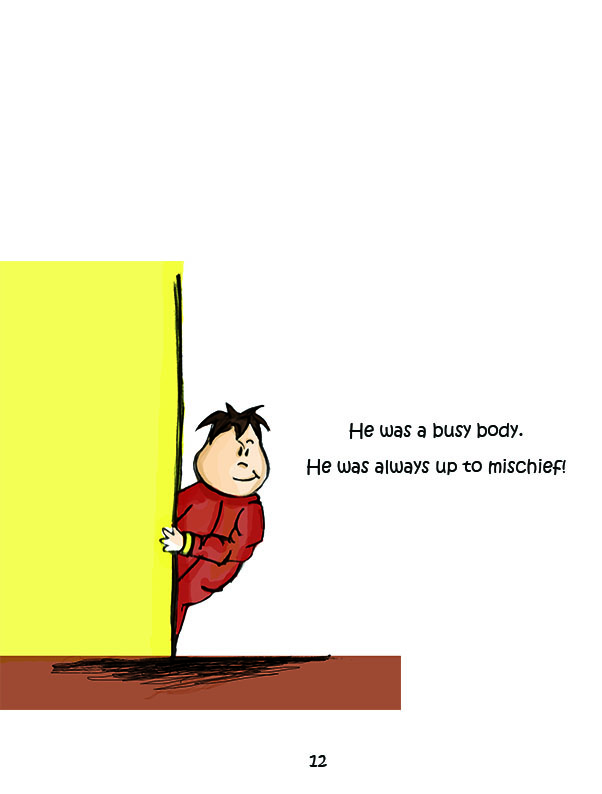
The story continues through John growing up and how he learned to talk. It shows the transformation from being able to say nothing to being able to express his feelings verbally. It also shows the reader all the mischief the character gets up too and reveals the little sense of danger the character with autism possesses.  From naturalistic observation, the author recalls the times where her brother would get himself into all kinds of dangerous situations. He would climb up on to the roof of the house, climb up trees and run across the road without checking for cars. He had no fear in what could happen next. 

The narrative also recalls the times when John would do the things he shouldn’t do. Like drawing on the walls and cutting his own hair .  The story continues to John growing up and how he dealt with going to school and interacting with other people. It shows the transition from being a little baby who could not speak to a young man who becomes quite social and can express himself through words. The author recollects how he would talk to anyone and everyone as well as anything and everything, including himself.